928 字
5 分钟
【CG】150行C++路径追踪
学了 离线渲染 相关的知识这么久了,自己也写过一些渲染器,但是我认为我对渲染器中的积分器的实现的理解还是不够透彻,于是打算写一个简单的 path tracer 程序来加深自己的印象
,于是就得到了(无第三方库
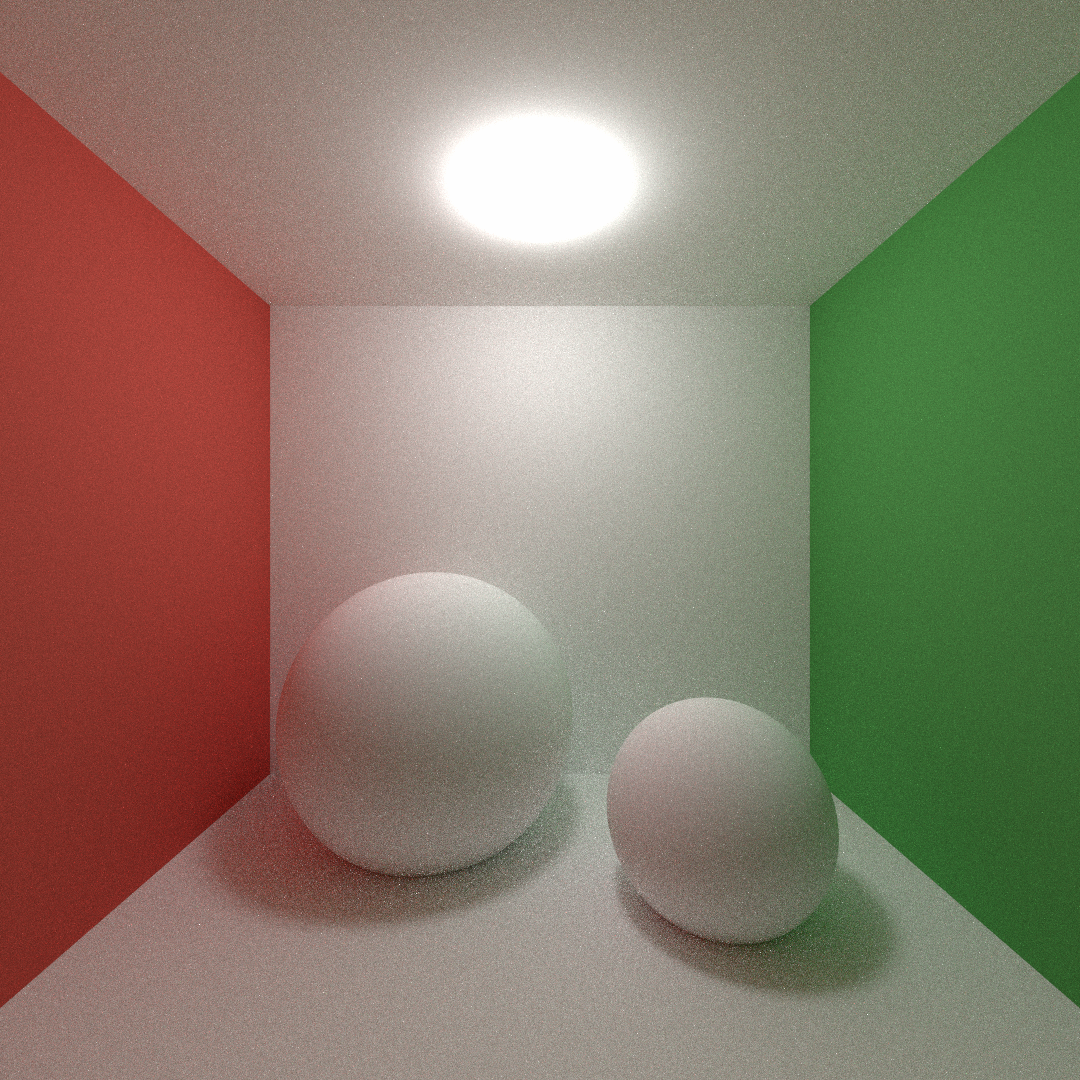 代码
代码
#include <cmath>#include <iostream>#include <random>#include <vector>constexpr float EPSILON = 1e-5f;constexpr float PI = 3.14159265358979323846f;struct Vec3 { float x, y, z; Vec3(float x, float y, float z) : x(x), y(y), z(z) {} Vec3() : x(0), y(0), z(0) {} Vec3 operator+(const Vec3 &other) const { return Vec3(x + other.x, y + other.y, z + other.z); } Vec3 operator-(const Vec3 &other) const { return Vec3(x - other.x, y - other.y, z - other.z); } Vec3 operator*(float other) const { return Vec3(x * other, y * other, z * other); } Vec3 operator*(Vec3 other) { return Vec3(x * other.x, y * other.y, z * other.z); } Vec3 operator-() const { return Vec3(-x, -y, -z); }};Vec3 normalize(Vec3 v) { return v * (1.0f / sqrt(v.x * v.x + v.y * v.y + v.z * v.z)); }float dot(Vec3 a, Vec3 b) { return a.x * b.x + a.y * b.y + a.z * b.z; }float clamp(float x, float min, float max) { return x < min ? min : (x > max ? max : x);}float linear_to_srgb(float x) { x = clamp(x, 0.0f, 1.0f); if (x <= 0.0031308f) return 12.92f * x; return 1.055f * std::pow(x, 1.0f / 2.4f) - 0.055f;}struct Ray { Vec3 origin; Vec3 direction; Ray(Vec3 origin, Vec3 direction) : origin(origin), direction(direction) {} Vec3 at(float t) const { return origin + direction * t; }};struct Sphere { Sphere(float radius, Vec3 center, Vec3 color, bool light = false): radius(radius), center(center), color(color), is_light(light) {} float radius; Vec3 center; Vec3 color; bool is_light = false;};struct HitInfo { bool is_hit; float t; Vec3 position; Vec3 normal; Sphere const* sphere = nullptr;};HitInfo intersect(const Ray &ray, const Sphere &sphere) { Vec3 oc = ray.origin - sphere.center; float b = 2.0f * dot(oc, ray.direction); float c = dot(oc, oc) - sphere.radius * sphere.radius; float discriminant = b * b - 4.0f * c; if (discriminant < 0.0f) return {false, 0.0f, Vec3(), Vec3(), &sphere}; float sqrt_d = sqrt(discriminant); float t0 = (-b - sqrt_d) * 0.5f,t1 = (-b + sqrt_d) * 0.5f; float t = t0; if (t < EPSILON) t = t1; if (t < EPSILON) return {false, 0.0f, Vec3(), Vec3(), &sphere}; return {true, t, ray.at(t), normalize(ray.at(t) - sphere.center), &sphere};}float random_float() { thread_local std::mt19937 gen(std::minstd_rand{}()); thread_local std::uniform_real_distribution<float> dis(0.0f, 1.0f); return dis(gen);}Vec3 sampling_hemisphere(const Vec3 &normal) { float z = random_float(); float r = std::sqrt(1.0f - z * z); float phi = 2.0f * PI * random_float(); Vec3 local(r * std::cos(phi), r * std::sin(phi), z); Vec3 tangent; if (std::abs(normal.x) > 0.9f) tangent = normalize(Vec3(0.0f, 1.0f, 0.0f) - normal * normal.y); else tangent = normalize(Vec3(1.0f, 0.0f, 0.0f) - normal * normal.x); Vec3 bitangent = Vec3(normal.y * tangent.z - normal.z * tangent.y,normal.z * tangent.x - normal.x * tangent.z,normal.x * tangent.y - normal.y * tangent.x); return normalize(tangent * local.x + bitangent * local.y + normal * local.z);}Vec3 Lo(Ray ray, const std::vector<Sphere> &spheres, int depth) { if (depth <= 0) return Vec3(); float rr_prob = 0.9f; if (random_float() > rr_prob) return Vec3(); HitInfo nearest_hit; nearest_hit.t = 1e10; nearest_hit.is_hit = false; for (auto &sphere : spheres) { HitInfo hit = intersect(ray, sphere); if (hit.is_hit && hit.t < nearest_hit.t) nearest_hit = hit; } if (!nearest_hit.is_hit) return Vec3(); if (nearest_hit.sphere->is_light) { Vec3 Le = nearest_hit.sphere->color * 30.0f; return Le; } Vec3 wo = -ray.direction,wi = sampling_hemisphere(nearest_hit.normal); float pdf = 1.0f / (2.0f * PI); Vec3 f_r = nearest_hit.sphere->color * (1.0f / PI); float cos_theta = dot(wi, nearest_hit.normal); Ray new_ray = Ray(nearest_hit.position + nearest_hit.normal * EPSILON, wi); Vec3 Li = Lo(new_ray, spheres, depth - 1); return f_r * Li * cos_theta * (1.0f / (rr_prob * pdf));}int main() { int image_width = 256, image_height = 256,samples_per_pixel = 1024; std::vector<Vec3> framebuffer(image_width * image_height); Sphere left_wall = {1000.0f, Vec3(-1003.0f, 0.0f, -6.0f), Vec3(0.75f, 0.12f, 0.10f)}; Sphere right_wall = {1000.0f, Vec3(1003.0f, 0.0f, -6.0f),Vec3(0.12f, 0.45f, 0.12f)}; Sphere back_wall = {1000.0f, Vec3(0.0f, 0.0f, -1006.0f), Vec3(1.0f, 1.0f, 1.0f)}; Sphere floor = {1000.0f, Vec3(0.0f, -1002.6f, -6.0f), Vec3(1.0f, 1.0f, 1.0f)}; Sphere ceiling = {1000.0f, Vec3(0.0f, 1002.6f, -6.0f), Vec3(1.0f, 1.0f, 1.0f)}; Sphere light = {0.35f, Vec3(0.0f, 2.6f, -4.0f), Vec3(1.0f, 1.0f, 1.0f), true}; Sphere big_sphere = {1.3f, Vec3(-1.0f, -1.6f, -5.0f), Vec3(1.0f, 1.0f, 1.0f)}; Sphere small_sphere = {0.8f, Vec3(1.3f, -2.0f, -4.0f), Vec3(1.0f, 1.0f, 1.0f)}; std::vector<Sphere> spheres = {left_wall, right_wall, back_wall,floor,ceiling,light,big_sphere, small_sphere}; std::cout << "P3\n" << image_width << ' ' << image_height << "\n255\n"; for (int j = 0; j < image_height; j++) { for (int i = 0; i < image_width; i++) { Vec3 color; for (int s = 0; s < samples_per_pixel; s++) { float u = (((double(i) + random_float()) / image_width)-0.5f)*2; float v = (((double(j) + random_float()) / image_height)-0.5f)*-2; Vec3 ray_direction = normalize(Vec3(u, v, -1)); Ray ray = Ray(Vec3(), ray_direction); color = color + Lo(ray, spheres, 10); } color = color * (1.0f / samples_per_pixel); int ir = static_cast<int>(linear_to_srgb(color.x) * 255.0f); int ig = static_cast<int>(linear_to_srgb(color.y) * 255.0f); int ib = static_cast<int>(linear_to_srgb(color.z) * 255.0f); std::cout << ir << ' ' << ig << ' ' << ib << '\n'; } }}【CG】150行C++路径追踪
https://blog.cglab.top/posts/cg/untitlea005/分享文章
生成精美分享图或复制链接,与更多人分享本文。
继续阅读
最后更新于 ,距今已过 63 天
部分内容可能已过时